JFK
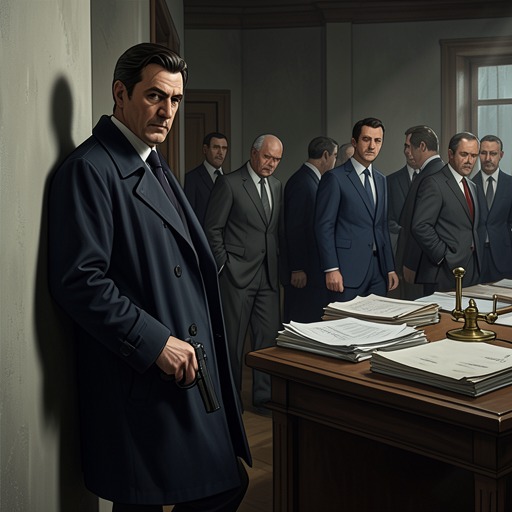
I Heard You Paint HousesJFK is depicted indirectly, through Frank Sheeran’s recollections of Sam Giancana and the mob’s political entanglements. Sheeran presents Giancana as a powerful ally who helped JFK win office and was later exposed to a crackdown associated with Bobby Kennedy; the account makes that reversal part of the dangerous world surrounding James R. Hoffa, Russell Bufalino, and Sheeran himself. These claims are the narrator’s version of events, not a separately corroborated account in the evidence presented here.
A Political Connection Recalled Through Giancana
The book’s most personal claim about JFK comes in a conversation between Sheeran and James R. Hoffa after Giancana has been killed. Sheeran tells Hoffa that Giancana shared a mistress, Judith Campbell, with JFK while JFK was president. He also alleges that Giancana helped get JFK elected. The relationship is thus presented not as a formal political alliance, but as an overlap of private intimacy, electoral assistance, and mob influence.
Sheeran’s telling adds a sharp reversal: after receiving Giancana’s help, JFK allegedly turned against him by allowing Bobby Kennedy to pursue the mob. Sheeran describes this as betrayal, and Hoffa’s angry response turns the story toward the danger of records and exposure. Hoffa warns that Giancana should have kept records and says that he himself keeps them; if anything unnatural happens to him, the records will come out. The passage links the alleged political debt to the book’s larger atmosphere of surveillance, retaliation, and feared disclosure.
Sheeran also makes a sweeping, accusatory claim about the Kennedy brothers’ private lives, describing the White House as a place they used for sexual encounters. The remark belongs to his account of Giancana’s political grievances; it is not presented with independent substantiation. Its function in the narrative is to intensify the contrast between Giancana’s closeness to political power and his later vulnerability to it.
Cuba, the U.S. Central Intelligence Agency, and Public Exposure
JFK’s political world is further connected to Giancana through the book’s account of Cuba. Sheeran says Giancana had casinos in Havana and that, alongside Russell Bufalino, he worked on behalf of the U.S. Central Intelligence Agency in connection with the Bay of Pigs invasion in 1961 and a 1962 plot to kill Fidel Castro. The narrative presents these covert activities as part of Giancana’s reach beyond Chicago, but does not establish that JFK personally directed them.
According to Sheeran, a Time report naming Bufalino and Giancana in those operations appeared about a week before Giancana was killed. He emphasizes Bufalino’s aversion to seeing his name in print, making publicity itself a source of danger. The U.S. Senate had subpoenaed Giancana to testify about the U.S. Central Intelligence Agency’s use of organized crime in a plot to assassinate Fidel Castro. Sheeran says Giancana was killed four days before he was due to appear, shot in his kitchen in a manner he characterized as Sicilian. In this sequence, secret cooperation gives way to public exposure, and a scheduled appearance before the Senate ends in murder.
The account does not say that JFK ordered Giancana’s killing. Instead, it places JFK within a political history in which Giancana allegedly helped a candidate, became entangled in covert activity connected to Cuba, and then faced the consequences of government attention. Sheeran’s narrative leaves the exact boundaries of JFK’s personal knowledge and responsibility unresolved.
The Narrator’s Position in the Network
Sheeran’s account presents him as close to Bufalino, the other mob figure named in the reported Cuba operations. He describes driving Bufalino across several states for meetings and says that he was trusted with ordinary personal access: he knew Bufalino’s wife, brought food, shared homemade wine, and was asked after his children. In November 1957, he drove Bufalino to Apalachin and dropped him at a house without understanding what was happening. The following day, arrests at the Apalachin meeting made the scale of the criminal network apparent to him.
That history does not independently verify Sheeran’s claims about JFK or Giancana. It does, however, show how the book situates its narrator: close enough to Bufalino to provide transport and personal assistance, and later describing messages and associations that crossed between political, labor, and criminal worlds. The distance between firsthand access and secondhand political interpretation is important to the portrait of JFK, which reaches the reader through Sheeran’s recollection of what Giancana had done and how the Kennedy administration allegedly responded.
Narrative Significance and Limits
JFK is not developed here through a sustained account of his presidency. He enters the story as a figure in Giancana’s rise and reversal: a beneficiary of alleged mob help, a man associated with Giancana through Campbell, and the president whose administration Sheeran says permitted Bobby Kennedy’s pursuit of organized crime. Cuba and the Senate subpoena widen that account from personal betrayal into a public and covert political crisis.
The perspective remains tightly attributed. Sheeran’s claims about Giancana’s political aid, the shared mistress, the Kennedy brothers’ private lives, and the administration’s role are presented as his recollections and judgments. The narrative supplies specific surrounding details—the reported Time article, the subpoena, and Giancana’s killing shortly before his scheduled testimony—while leaving JFK’s direct knowledge of those events unestablished. That combination gives the portrait its force and its limit: it shows how the narrator’s criminal network interprets political power, without resolving every allegation it makes about the president.